Passion Twists
Rope-Twist Family
Also known as: Bohemian twists, Boho twists, Passion twist, Passion twists hairstyle
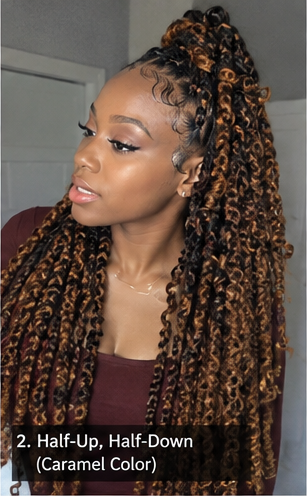
Illustration -- About our illustrations
Passion twists are two-strand twists made with wavy or curly extension hair, which gives them a soft, fluffy, slightly undone texture instead of a sleek rope look. Each twist starts with your own hair and the extension hair together at the root and is twisted down to the ends, which are left loose and curly. The style was created by Miami hairstylist Kailyn Rogers, who shared a tutorial in 2018 and named it after her mother, Passion. It's usually made with water-wave braiding hair; crochet versions that use pre-twisted hair are also common and quicker to install.
Distinguishing characteristics
Texture is the tell. Passion twists look bouncy and a little fuzzy along the length, with curly, unsealed ends. Senegalese twists use smooth hair for a sleek, uniform rope with neat, sealed ends. Both are two-strand twists, so the difference comes mostly from the hair used and the finish. Passion twists also differ from braids: each twist is two strands wound around each other, not three strands plaited together.
Advantages
A soft, textured, lived-in look that doesn't have to be perfect. Crochet versions install relatively quickly. A bit of frizz as the weeks go on tends to suit the style rather than spoil it.
Considerations
The curly extension hair tangles and can mat at the ends, especially with friction. It takes a lot of hair (the style's creator suggests eight or more packs for a full look), which adds to the cost. Hand-twisted installs take several hours. Twists can unravel at the ends over time, and tight roots or heavy hair can strain the hairline.
Warning signs
Twisting shouldn't hurt. Pain, stinging, tight or tented skin at the roots, bumps, crusting or headaches mean the twists are too tight and should be loosened or taken out. Check your hairline regularly for broken hairs or thinning. Plan a limited wear time: the style's creator suggests up to about eight weeks with good care, in line with dermatologists' advice to limit how long tension styles stay in. See a board-certified dermatologist if irritation or hair loss continues.
Preparation
Start with washed, conditioned, fully detangled hair; many stylists prefer it stretched or blow-dried. Ask how many packs of hair you'll need, which depends on size, length and fullness, and whether hair is included. Decide between hand-twisted and crochet installation; crochet is usually faster.
Daily Care
Keep your scalp comfortable with a light leave-in or moisturizer, and use a little mousse or setting foam to smooth flyaways as the twists start to frizz. Some frizz is part of the look. Avoid heavy oils that weigh the twists down or build up at the roots.
Night Care
Cover your twists with a satin or silk bonnet or scarf, or sleep on a satin pillowcase. The curly ends tangle easily, so tuck them in or pile the twists loosely on top of your head.
Washing
Wash gently, because rough washing can loosen twists. Apply diluted shampoo to your scalp, massage with your fingertips and let the rinse water run down the twists instead of rubbing them. Squeeze out water with a towel and let the twists dry fully.
Removal
For crochet versions, carefully unhook the added hair first. Otherwise, unwind each twist from the end, separate the extension hair, and remove shed hair gently with your fingers and some conditioner. If you meet resistance or matting, add more conditioner rather than pulling.
At a glance
- Estimated price
- $150–$300
Planning estimate, not a validated market benchmark -- local salon pricing varies and this figure should not be treated as a typical or standard price. - Chair time
- 3–8 hrs
- Sizes
- Medium, Small, Large
- Lengths
- Mid-Back Length, Shoulder Length, Waist Length
- Looks
- 9 looks
Looks
- Island Twists
- Medium Passion Twists -- Medium, Mid-Back Length, Natural Black, Soft Swoops, Tapered
- Short Passion Twists -- Medium, Shoulder Length, Natural Black, Soft Swoops, Tapered
- Long Passion Twists -- Medium, Waist Length, Natural Black, Soft Swoops, Tapered
- Small Passion Twists -- Small, Mid-Back Length, Natural Black, Soft Swoops, Tapered
- Jumbo Passion Twists -- Large, Mid-Back Length, Natural Black, Soft Swoops, Tapered
- Passion Twists with Curly Ends -- Medium, Mid-Back Length, Natural Black, Soft Swoops, Curled
- Ombre Passion Twists -- Medium, Mid-Back Length, Natural Black, Soft Swoops, Tapered
- Passion Twist Bob -- Medium, Shoulder Length, Natural Black, Soft Swoops, Tapered
Price & time
- Estimated price: $150–$300
- Estimated time: 3–8 hrs
- Confidence: Medium
Planning estimate, not a validated market benchmark -- local salon pricing varies and this figure should not be treated as a typical or standard price.
US national estimate.
FAQs
- What are Passion Twists?
Passion twists are two-strand twists made with wavy or curly extension hair, which gives them a soft, fluffy, slightly undone texture instead of a sleek rope look. Each twist starts with your own hair and the extension hair together at the root and is twisted down to the ends, which are left loose and curly.
- How are passion twists different from Senegalese twists?
Both are two-strand twists made with extension hair. Senegalese twists use smooth hair for a sleek, rope-like finish with sealed ends; passion twists use wavy hair and leave the ends curly for a fluffier look.
- Should Passion Twists hurt?
No. Each twist starts with your own hair and the extension hair together at the root; that should feel snug, not sore. Pain, stinging, a headache, a tight or tented scalp, or small bumps mean it's too tight: ask for those twists to be loosened or redone straight away rather than waiting for them to settle.
- Do Passion Twists require extension hair?
Yes. Passion twists are made with wavy or curly extension hair. Ask how many packs you'll need and whether the hair is included in the price.
- How long can I keep Passion Twists installed?
Usually about 4–8 weeks, depending on twist size and care; larger twists tend to frizz and unravel sooner. Take them out sooner if your scalp is sore or itchy, the curly ends are matting, or the twists pull at your edges.
Related styles
- Senegalese Twists -- Both are two-strand twists made with extension hair. Senegalese twists are sleek and rope-like; passion twists use wavy hair for a fluffier, textured finish. Compare
Sources
- Traction alopecia (DermNet New Zealand)
- Black hair: Tips for everyday care (American Academy of Dermatology Association)
- Passion Twists Protective Style - How to Do Passion Twists 2022 (ELLE)
- Hairstyles that pull can lead to hair loss (American Academy of Dermatology Association)