Hand-Tied Weft Extensions
Sew-In Family
Also known as: Hand-Tied Extensions
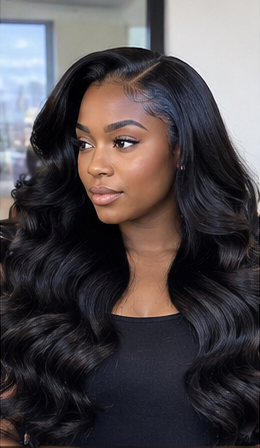
Illustration -- About our illustrations
Hand-Tied Weft Extensions add hair in narrow wefts made by tying hair onto a fine supporting seam. Hand-tied describes how the weft is made; the stylist must separately explain how those wefts will be attached to your hair.
Distinguishing characteristics
A beaded-row service creates attachment points and sews the weft to that foundation. Manufacturer training documents this approach, but a hand-tied weft is not itself the name of one universal row method. It differs from individual micro-link strands and a traditional cornrow-based sew-in.
Advantages
Wefts can add fullness across a planned area without placing a separate bond on every extension strand. Length and shade can be selected independently of the row plan.
Considerations
The row and seam require access for cleaning and professional upkeep. More rows or stacked wefts add bulk and load; a fine seam alone does not make the installation suitable for fragile hair.
Warning signs
Ask for adjustment if row ends hurt or pull. Seek assessment for bead-site sores, rash, thinning or continuing discomfort.
Preparation
Ask for the weft brand, row method, expected maintenance and removal costs. Discuss density at the intended attachment areas and the coverage needed to conceal the seam. Follow that system's preparation policy without assuming every texture needs flat-ironing.
Daily Care
Support the row while brushing the lengths and keep tangles from collecting above the attachment line. Do not force a brush or tool underneath the seam.
Night Care
Arrange the lengths loosely and avoid sleeping with wet attachment areas. Keep a tight bedtime ponytail from pulling on the row ends.
Washing
Clean the accessible scalp gently and follow the installed system's product directions. Rinse and dry around the row; ask the fitter to demonstrate access if the weft feels difficult to lift safely.
Scalp Care
Check row ends and bead sites for pressure or rubbing. Do not hide a sore area by adding another weft above it.
Refreshing
Attend the fitter's planned move-up checks. A slipping row, tangling at regrowth or a visible attachment should be assessed rather than tightened at home.
Removal
Have the sewing thread and attachment beads removed professionally. Cutting near the seam risks confusing thread with the wearer's hair.
Styling tips
Choose your normal parting and preferred updos with the fitter before rows are placed. Ask which movements expose the seam and how to gather the lengths without pulling on the foundation. Hand-tied describes the weft's manufacture; styling freedom also depends on the attachment system and placement.
At a glance
- Estimated price
- $200–$2000
Planning estimate, not a validated market benchmark -- local salon pricing varies and this figure should not be treated as a typical or standard price. - Chair time
- 2–5 hrs
- Sizes
- Medium
- Lengths
- Mid-Back Length, Shoulder Length, Waist Length
- Looks
- 4 looks
Looks
- Medium Mid-Back Hand-Tied Weft Extensions -- Medium, Mid-Back Length, Natural Black
- Shoulder-Length Hand-Tied Weft Extensions -- Medium, Shoulder Length, Natural Black
- Full Waist-Length Hand-Tied Weft Extensions -- Medium, Waist Length, Natural Black
- Medium Brown Hand-Tied Weft Extensions -- Medium, Mid-Back Length, Medium Brown
Price & time
- Estimated price: $200–$2000
- Estimated time: 2–5 hrs
- Confidence: Medium
Planning estimate, not a validated market benchmark -- local salon pricing varies and this figure should not be treated as a typical or standard price.
US national estimate; higher in major cities.
Culture & history
Hand-Tied Weft Extensions: A Beaded-Row Anchor with a Hand-Sewn Weft
Hand-Tied Weft Extensions anchor to the natural hair using a row of small, silicone-lined beads clamped onto individual sections with a bead threader tool -- no braided cornrow track underneath. A thin weft made by hand-sewing hair onto a cotton-thread foundation on a loom (not machine-loomed, unlike the wefts used in Sew-In Weave) is then hand-stitched directly onto that beaded row with a curved needle and thread. No adhesive and no heat are used at any step, distinguishing this construction from Fusion Extensions and Tape-In Extensions as well as from Sew-In Weave's cornrow-track-and-thread method. Industry sources describe installation as roughly two to five hours, note that the resulting weft lies thinner and lighter against the head than a machine-made weft, and describe a substantially longer wear window -- roughly six to twelve months, with "move-up" appointments every six to eight weeks to reposition the beaded row as natural hair grows out -- than a cornrow-track sew-in typically allows before the track needs to be redone.
FAQs
- Are hand-tied wefts the same as individual micro-links?
No. A weft carries a strip of hair attached along a row; individual micro-link extensions attach separate strands. Clarify which service is being quoted before comparing the two.
Related styles
- Sew-In Weave -- Both are Sew-In Family siblings that stitch a weft of extension hair onto an anchor built into the natural hair, differing in weft construction (hand-sewn on a cotton-thread loom vs. machine-loomed) and anchor method (a beaded row vs. a braided cornrow track). Compare