Sew-In Weave
Sew-In Family
Also known as: Traditional Sew-In
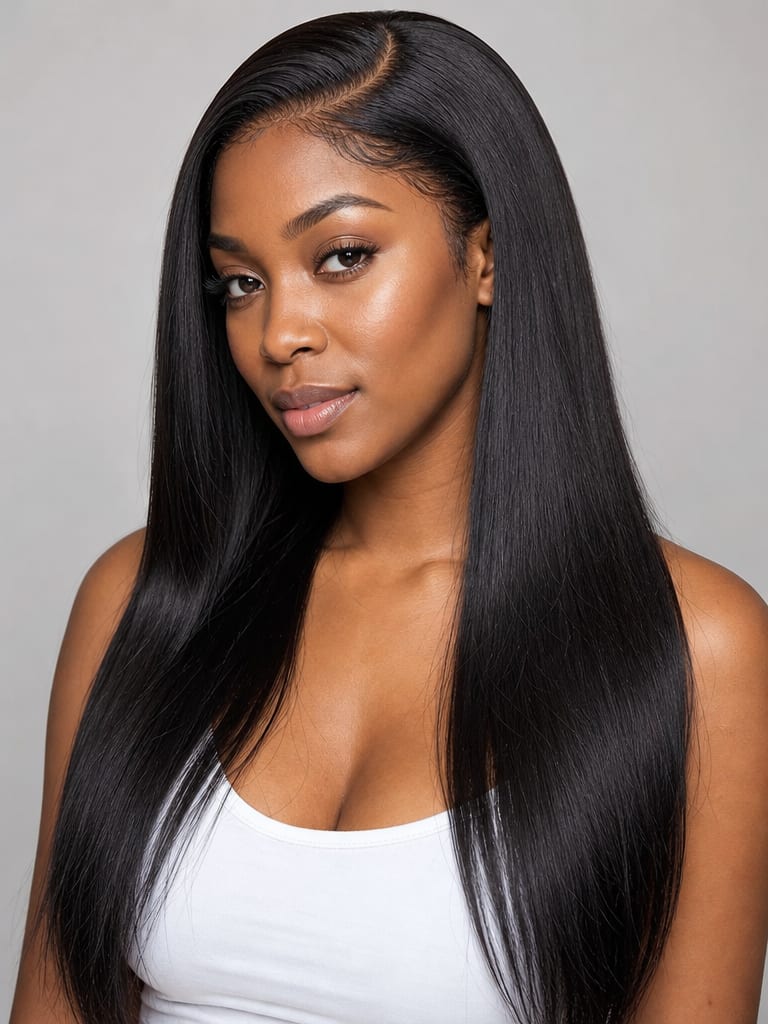
Illustration -- About our illustrations
A Sew-In Weave adds wefts of hair by sewing them to a prepared foundation, commonly cornrows. It can change length, volume and the visible finish while keeping the attachment method distinct from a bonded quick weave or individual strand extensions.
Distinguishing characteristics
The foundation supports the sewn tracks. Leave-out, closure coverage and braid layout need to be agreed separately; a sew-in does not necessarily mean all natural hair is concealed. Dermatology advice emphasizes comfortable cornrows and avoiding painful attachment tension.
Advantages
Can add a different finish without bonding adhesive at the weft attachment. Length, color and coverage can be planned separately from the natural hair.
Considerations
The foundation and tracks require cleaning access and removal time. Added weight and tight rows can still cause damage; sewn-in does not mean risk-free.
Warning signs
Request loosening for pain or pulling. Persistent scalp sores, track-site breakage or hairline thinning need professional or medical assessment.
Preparation
Ask the stylist to assess the supporting hair and hairline, explain scalp access and quote removal as well as installation. Discuss any exposed natural hair and how it will be blended without repeated high heat.
Daily Care
Detangle the added lengths gently while supporting the foundation. Keep tangles from collecting near the sewn tracks and avoid pulling the finished hair into a tight updo.
Night Care
Loosely arrange the lengths and protect exposed natural ends. Avoid going to bed with a damp braided foundation or binding the weave tightly around the hairline.
Washing
Agree on a way to cleanse the scalp beneath the tracks, rinse thoroughly and dry the foundation. A routine for loose extensions alone is insufficient if the braided base stays wet.
Scalp Care
Inspect accessible partings and track edges. An installation that makes comfort or scalp hygiene difficult needs assessment, even when the top layer looks tidy.
Refreshing
Have loose tracks or exposed regrowth checked professionally. Do not tighten stitches against an irritated base to extend wear.
Removal
Have the sewing thread identified and cut carefully before unbraiding the base. Stop if it is difficult to distinguish thread from hair, then detangle shed hair gently after the tracks are released.
Styling tips
Choose the parting, leave-out or closure arrangement before the foundation is braided. Ask how the finished tracks will stay covered in your usual styles without pulling the braids underneath. Match any exposed hair gently; do not assume it should receive repeated heat simply because extensions are present.
At a glance
- Estimated price
- $100–$300
Planning estimate, not a validated market benchmark -- local salon pricing varies and this figure should not be treated as a typical or standard price. - Chair time
- 3–6 hrs
- Sizes
- Medium
- Lengths
- Shoulder Length, Mid-Back Length, Waist Length
- Looks
- 7 looks
- Occasions
- Work / Office: Suited with tradeoffs
Looks
- Closure Sew-In
- Frontal Sew-In
- Leave-Out Sew-In
- Medium Shoulder-Length Sew-In Weave -- Medium, Shoulder Length, Natural Black
- Long Mid-Back Sew-In Weave -- Medium, Mid-Back Length, Dark Brown
- Waist-Length Sew-In Weave -- Medium, Waist Length, Natural Black
- Blonde Sew-In Weave -- Medium, Mid-Back Length, Blonde
Price & time
- Estimated price: $100–$300
- Estimated time: 3–6 hrs
- Confidence: Medium
Planning estimate, not a validated market benchmark -- local salon pricing varies and this figure should not be treated as a typical or standard price.
US national estimate; hours inferred relative to Quick Weave, not directly sourced.
Occasion & climate fit
Work / Office
Occasion · Suited with tradeoffs
Culture & history
Sew-In Weave: Christina Jenkins and the Track-and-Weft Method
The sew-in weave -- extension wefts sewn with a curved needle and thread onto a cornrowed natural-hair base ("tracks") -- is widely credited to Christina Jenkins, who developed and patented the modern weaving technique in the 1950s. The construction is categorically different from every braided, twisted, or loc-based style: the natural hair is fully cornrowed flat first as a foundation, and the visible styled hair is entirely wefted extension hair attached along that foundation, not individual strands of the wearer's own hair worked directly.
FAQs
- Does a sew-in cover all my natural hair?
Not necessarily. Depending on the plan, some natural hair may be left out at the front or crown, or a closure may cover the top. Confirm how much of your hair stays visible and how to care for it.
- Should the cornrows or stitches feel tight for security?
No. Painful pulling is not a sign of a secure install. Speak up during fitting so the tension can be adjusted rather than waiting for it to ease.
- What happens during sew-in removal?
The thread holding the wefts is cut and removed carefully, the wefts are lifted off, and the cornrow base is unbraided. Take care to tell the thread apart from your own hair; never cut blindly to speed things up.
Related styles
- Quick Weave -- Genuinely different, competing installation methods (bonded/glued vs. sewn onto cornrow tracks) commonly compared by consumers deciding between them -- not a nested technique pair. Compare
- Hand-Tied Weft Extensions -- Both are Sew-In Family siblings that stitch a weft of extension hair onto an anchor built into the natural hair, differing in weft construction (hand-sewn on a cotton-thread loom vs. machine-loomed) and anchor method (a beaded row vs. a braided cornrow track). Compare