Bantu Knots
Coil & Knot Family
Also known as: Zulu Knots
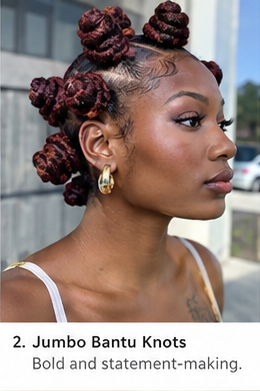
Illustration -- About our illustrations
Bantu knots are small, coiled knots of natural hair sitting in sections across the head. Each section is twisted or coiled and then wound around its own base until it forms a compact knot, which is tucked or pinned to hold. They are worn as a style in their own right or unravelled the next day for a curly knot-out.
Distinguishing characteristics
The section is wrapped around its own base, so the knot sits on the scalp rather than hanging. Parting shape (squares, triangles, zigzags) is part of the look. The same set unravelled becomes Bantu Knot-Outs, a separate style on this site.
Advantages
A striking style that needs only your own hair, and doubles as a set for curls.
Considerations
Short-lived compared with braided styles; tight knots can be uncomfortable to sleep on.
Warning signs
Soreness or bumps at the base of the knots mean they are wound too tightly.
Preparation
Start with clean, detangled hair. Apply a leave-in and a holding product such as a curl cream or gel, section neatly, and keep sections similar in size for even knots.
Daily Care
Mist lightly with water if the hair feels dry, and avoid pulling the knots to adjust them.
Night Care
Cover the knots with a satin scarf or bonnet so they keep their shape.
Washing
Bantu knots are usually worn for days rather than weeks; wash after taking them down.
Scalp Care
Wrapping too tightly around the base pulls on the scalp; knots should feel secure, not sore.
Refreshing
Re-wind any knots that have loosened and smooth the edges.
Removal
Unwind each knot in the opposite direction with oiled fingers. Keep the coils intact for a knot-out, or detangle gently if you are washing.
Styling tips
Small knots give a tighter curl when released; large knots make a bold statement. Accessories like gold cuffs or pearls suit formal versions.
At a glance
- Estimated price
- $50–$145
Planning estimate, not a validated market benchmark -- local salon pricing varies and this figure should not be treated as a typical or standard price. - Chair time
- 2–3 hrs
- Sizes
- Medium, Small, Large
- Lengths
- Scalp Style
- Looks
- 4 looks
- Climate & activity
- Frequent Swimming / Water Activity: Suited with tradeoffs
Looks
- Classic Bantu Knots -- Medium, Scalp Style, Natural Black
- Small Bantu Knots -- Small, Scalp Style, Natural Black
- Large Bantu Knots -- Large, Scalp Style, Natural Black
- Dark Brown Bantu Knots -- Medium, Scalp Style, Dark Brown
Price & time
- Estimated price: $50–$145
- Estimated time: 2–3 hrs
- Confidence: Medium
Planning estimate, not a validated market benchmark -- local salon pricing varies and this figure should not be treated as a typical or standard price.
US national estimate.
Occasion & climate fit
Frequent Swimming / Water Activity
Climate & activity · Suited with tradeoffs
Culture & history
Bantu Knots and Bantu-Speaking Southern and Central African Origins
Bantu knots take their name from Bantu-speaking peoples across Central and Southern Africa, with Zulu communities specifically credited with generations of continuous practice -- the style is sometimes called Zulu knots for this reason, though the coiled-knot construction appears across multiple Bantu-speaking groups, each with its own cultural meaning attached to the practice. Construction (coiling a section of hair around itself and securing the coil, without added extensions) is well documented and distinct from every other family in this catalog.
Related styles
- Bantu Knot-Outs -- A Bantu Knot-Out is the styled result of installing Bantu Knots, then unraveling them to leave a defined curl pattern -- a process/lineage relationship, not a construction hierarchy. Compare