Stitch Braids
Cornrow Construction Family
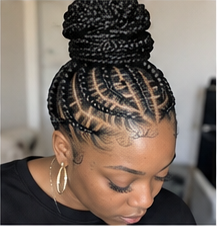
Illustration -- About our illustrations
Stitch braids are cornrows with a signature detail: evenly spaced horizontal lines along each row that look like stitches. The braider makes them by using the tail of a comb or a fingernail to part small, even sections across the row before picking each one up into the braid. Most stitch braids also use feed-in extension hair, so the rows start slim and grow fuller. They're usually worn straight back but can also be side-swept, zigzagged, mixed in size, or finished in a ponytail or bun.
Distinguishing characteristics
Look at the surface of each row. Stitch braids show a clear line of short horizontal parts running along the braid at regular intervals, a bit like a ladder. Regular cornrows pick up hair smoothly, so those lines aren't there. Stitch describes how the hair is sectioned, while feed-in describes how extension hair is added, so the two are often combined. The crisp stitch lines depend on neat parting and styling product, and they're most visible while the braids are fresh.
Advantages
A sharp, graphic look that stands out even in a simple straight-back set. Works with many layouts, from two braids to full sets, ponytails and buns. Keeps hair flat and out of the way, and is usually quicker to install than a full head of small individual braids.
Considerations
The stitch lines soften as hair frizzes and grows, so the style looks sharpest in its first weeks. Neat stitching takes skill and extra time. Like any cornrow style, tight rows and tight ponytails can strain the hairline. Pricing is less settled than for longer-established styles, so quotes vary widely.
Warning signs
Stitch braids should feel secure, not sore. If a row stings, throbs, raises bumps, forms crusts, pulls the skin up into a tent at its base, or gives you a headache, it is too tight and should be loosened or taken out. Watch your hairline for broken hairs or thinning, checking at least monthly, and aim to remove the braids within 6–8 weeks, as the American Academy of Dermatology recommends. See a board-certified dermatologist if problems continue after removal.
Preparation
Start with clean, conditioned, thoroughly detangled hair. Stretched hair makes it easier to part clean stitches, so ask your stylist whether to blow-dry beforehand. Decide on the number of rows and how closely spaced you want the stitches; more rows and tighter spacing mean a longer appointment. Mention any sensitive spots, thinning edges or recent chemical treatments.
Daily Care
Keep scalp products to a minimum; the styling gel used to set the stitches already sits on the scalp, and more product just builds up. Resist re-slicking or touching the parts every day, which roughens the stitch lines and stresses your edges.
Night Care
Wear a satin or silk scarf or durag at night. Pressing the rows flat under smooth fabric helps keep the stitch lines neat. Tuck long ends in loosely so the covering doesn't drag on your hairline.
Washing
Wash gently: apply diluted shampoo along the parts, massage with your fingertips and rinse well. Each wash softens the stitch lines a little. That's a normal trade-off, and keeping your scalp clean matters more than keeping the lines crisp. Dry your scalp completely afterwards.
Removal
Remove one row at a time from the end back toward the front, unravelling the added hair from your own. If product has built up at the roots, soften it with water or conditioner before detangling. Separate shed hair with your fingers before washing.
At a glance
- Estimated price
- $80–$200
Planning estimate, not a validated market benchmark -- local salon pricing varies and this figure should not be treated as a typical or standard price. - Chair time
- 2–5 hrs
- Sizes
- Medium, Small, Large, Mixed
- Lengths
- Bra-Strap Length, Mid-Back Length
- Looks
- 10 looks
Looks
- Classic Straight-Back Stitch Braids -- Medium, Bra-Strap Length, Natural Black, Soft Swoops, Tapered
- Small Stitch Braids -- Small, Mid-Back Length, Natural Black, Minimal Edges, Tapered
- Large Stitch Braids -- Large, Bra-Strap Length, Natural Black, Natural / No Styled Edges, Tapered
- Two Stitch Braids -- Large, Mid-Back Length, Natural Black, Soft Swoops, Tapered
- Side-Swept Stitch Braids -- Medium, Bra-Strap Length, Natural Black, Soft Swoops, Tapered
- Stitch Braid Ponytail -- Medium, Mid-Back Length, Natural Black, Soft Swoops, Gathered Ends
- Stitch Braid Bun -- Medium, Bra-Strap Length, Natural Black, Minimal Edges, Wrapped Bun
- Mixed-Size Stitch Braids -- Mixed, Mid-Back Length, Natural Black, Soft Swoops, Tapered
- Zigzag Stitch Braids -- Medium, Mid-Back Length, Natural Black, Minimal Edges, Tapered
- Ombre Stitch Braids -- Medium, Mid-Back Length, Natural Black, Soft Swoops, Tapered
Price & time
- Estimated price: $80–$200
- Estimated time: 2–5 hrs
- Confidence: Low
Planning estimate, not a validated market benchmark -- local salon pricing varies and this figure should not be treated as a typical or standard price.
US estimate based on limited salon pricing.
FAQs
- What are stitch braids?
Stitch braids are cornrow-based scalp braids with deliberate repeated section lines placed along each braid route. The visible lines come from organizing the hair into regular pickup sections as the braid is formed.
- Are stitch braids the same as cornrows?
Stitch braids are a type of cornrow. Both are braided continuously against the scalp, but stitch braids add repeated visible section lines. Standard cornrows may use smoother pickups without the stitch pattern.
- Are stitch braids the same as feed-in braids?
No. Stitch describes the visible sectioning pattern. Feed-in describes gradually adding extension hair. Many stitch braids also use feed-in hair, but the terms refer to different parts of the construction.
- Should stitch braids hurt?
No. The stitch lines come from small, even pickups, not from braiding tighter. Pain, stinging, a headache, a tight or tented scalp, or small bumps mean it's too tight: ask for those rows to be loosened or redone straight away rather than waiting for them to settle.
- Do stitch braids require extension hair?
Not necessarily. The stitch sectioning effect can be used with natural-hair cornrows, although many salon services add extension hair progressively for length, thickness, color, or a tapered finish.
- How long can stitch braids be worn?
Up to about 6–8 weeks, the limit the American Academy of Dermatology suggests for braids. The stitch lines look sharpest in the first week or two and soften as the hair frizzes, so many people take them out sooner for looks. Take them out straight away if they hurt or your edges start to thin.
- Can stitch braids be styled into a ponytail or bun?
Yes, but an updo can concentrate weight and directional pull. The route plan, extension quantity, base size, hairline condition, and comfort should be assessed before installation.
Related styles
- Cornrows -- Stitch braids are cornrows with evenly spaced horizontal part lines along each row; the braid underneath is the same. Compare
Sources
- Traction alopecia (DermNet New Zealand)
- Hairstyles that pull can lead to hair loss (American Academy of Dermatology Association)
- 14 Gorgeous Stitch Braids To Try in 2023 (StyleSeat)