Loc Extensions
Loc Extension Family
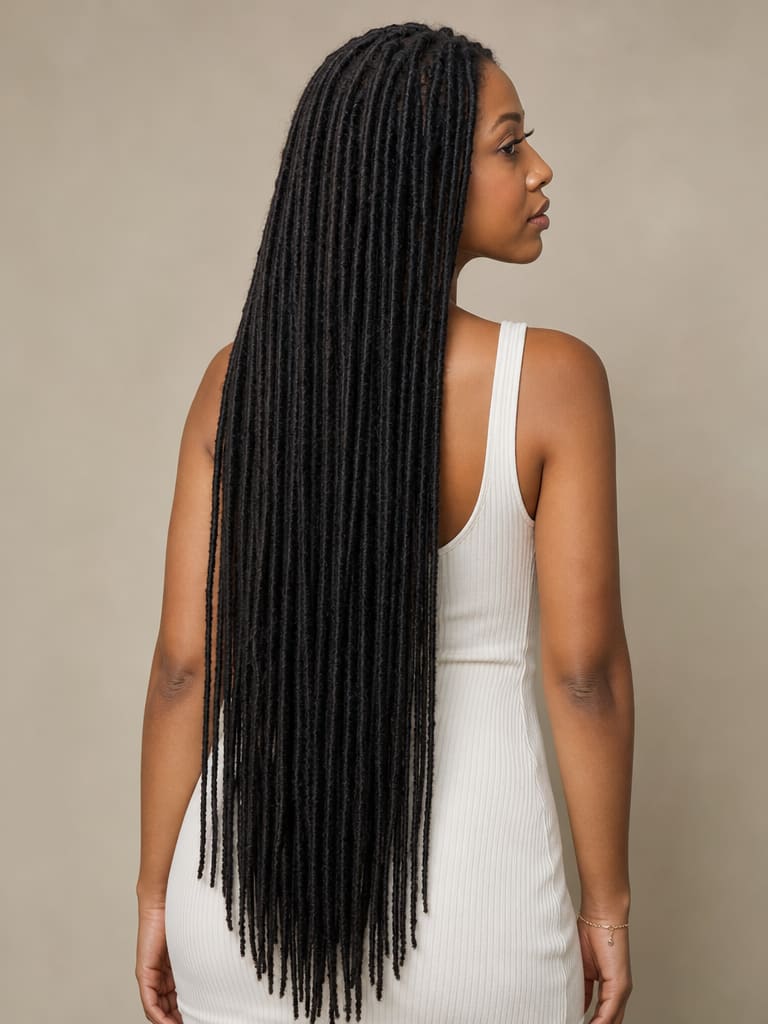
Illustration -- About our illustrations
Loc Extensions add prepared loc hair to create additional length or fullness. The service needs a clear attachment plan: extending an established loc and building a new loc with added hair are different situations and should not be treated as interchangeable.
Distinguishing characteristics
Added loc material must be matched to the supporting hair and the chosen attachment method. Professional loc standards include incorporating additional hair, maintenance and repair; they do not establish that every marketed bonding method is appropriate.
Advantages
Can change the length or outline of locs without waiting for equivalent natural growth. Placement and material can be discussed for a particular existing loc set.
Considerations
Adds material, weight and another maintenance point. Attachment choice affects removal, and long-term comfort cannot be inferred from how seamless the join looks.
Warning signs
Have a thinning base or painful join assessed promptly. Stop added tension and seek medical advice for scalp inflammation or hair loss.
Preparation
Identify whether the service is for existing locs or loose hair, which material is being added and how the connection will be made. Discuss the condition and diameter of the supporting locs, planned length, future maintenance and whether removal is intended.
Daily Care
Handle connections gently and check for slippage or tangling around them. Avoid repeatedly tugging at a join to test whether it is secure.
Night Care
Support added lengths in a loose arrangement. Avoid creating a high bundle that pulls the entire extension weight against the same roots.
Washing
Follow a method suitable for both the natural loc and the added material. Clean the scalp and allow the attachment and lengths to dry thoroughly; added hair does not remove the need to wash.
Scalp Care
Inspect bases as well as the visible joins. A neat connection is not proof that the natural root can comfortably support the added length.
Refreshing
Book assessment for slipping or separating joins. Do not conceal a weak connection under extra added material without checking the natural loc.
Removal
Agree on removal before installation. Some connections may require a different approach from undoing temporary braids; do not promise that all added hair will come out without loss of natural length.
Styling tips
Agree on the finished length and outline before adding hair. When gathering the lengths, avoid using the attachment junction as the point that carries a tight updo. If a connection looks or feels different from the surrounding loc, have it assessed instead of concealing it with decoration.
At a glance
- Estimated price
- $300–$900
Planning estimate, not a validated market benchmark -- local salon pricing varies and this figure should not be treated as a typical or standard price. - Chair time
- 4–16 hrs
- Sizes
- Medium
- Lengths
- Waist Length, Hip Length
- Looks
- 4 looks
- Occasions
- Work / Office: Suited with tradeoffs
Looks
- Medium Waist-Length Loc Extensions -- Medium, Waist Length, Natural Black
- Synthetic Wax-Bonded Loc Extensions -- Medium, Waist Length, Natural Black
- Crochet Loc Extensions -- Medium, Waist Length, Natural Black
- Human-Hair Wax-Bonded Loc Extensions -- Medium, Hip Length, Natural Black
Price & time
- Estimated price: $300–$900
- Estimated time: 4–16 hrs
- Confidence: Medium
Planning estimate, not a validated market benchmark -- local salon pricing varies and this figure should not be treated as a typical or standard price.
US national estimate.
Occasion & climate fit
Work / Office
Occasion · Suited with tradeoffs
Culture & history
Loc Extensions: Adding Length to Already-Formed Locs
Loc Extensions attach human-hair or synthetic loc pieces onto hair that is already locked -- via interlocking, wax-bonding, or crochet -- to add length, thickness, or fullness. This is categorically a maintenance-stage service for people who already have real, established locs (from Traditional Locs, Sisterlocks, or Microlocs), not an initial loc-forming method and not a temporary faux-loc install on non-locked hair -- both of those are already separate styles in this catalog.
FAQs
- Is extending an existing loc the same as starting locs with added hair?
No. One begins with an established loc; the other begins with a different supporting structure. Describe what you currently have and ask which service and attachment method are proposed.
- Does added length remove the need for loc maintenance?
No. The natural hair, regrowth and connection still need an agreed care plan. Discuss cleansing access and inspection of the attachment instead of treating the added length as a finished, care-free result.
Related styles
- Traditional Locs -- Loc Extensions is a cross-cutting attachment method (interlock/crochet/other) that can extend multiple loc types, not exclusive to Traditional Locs specifically. Compare