Koroba Braids
Cornrow Construction Family
Also known as: Koroba
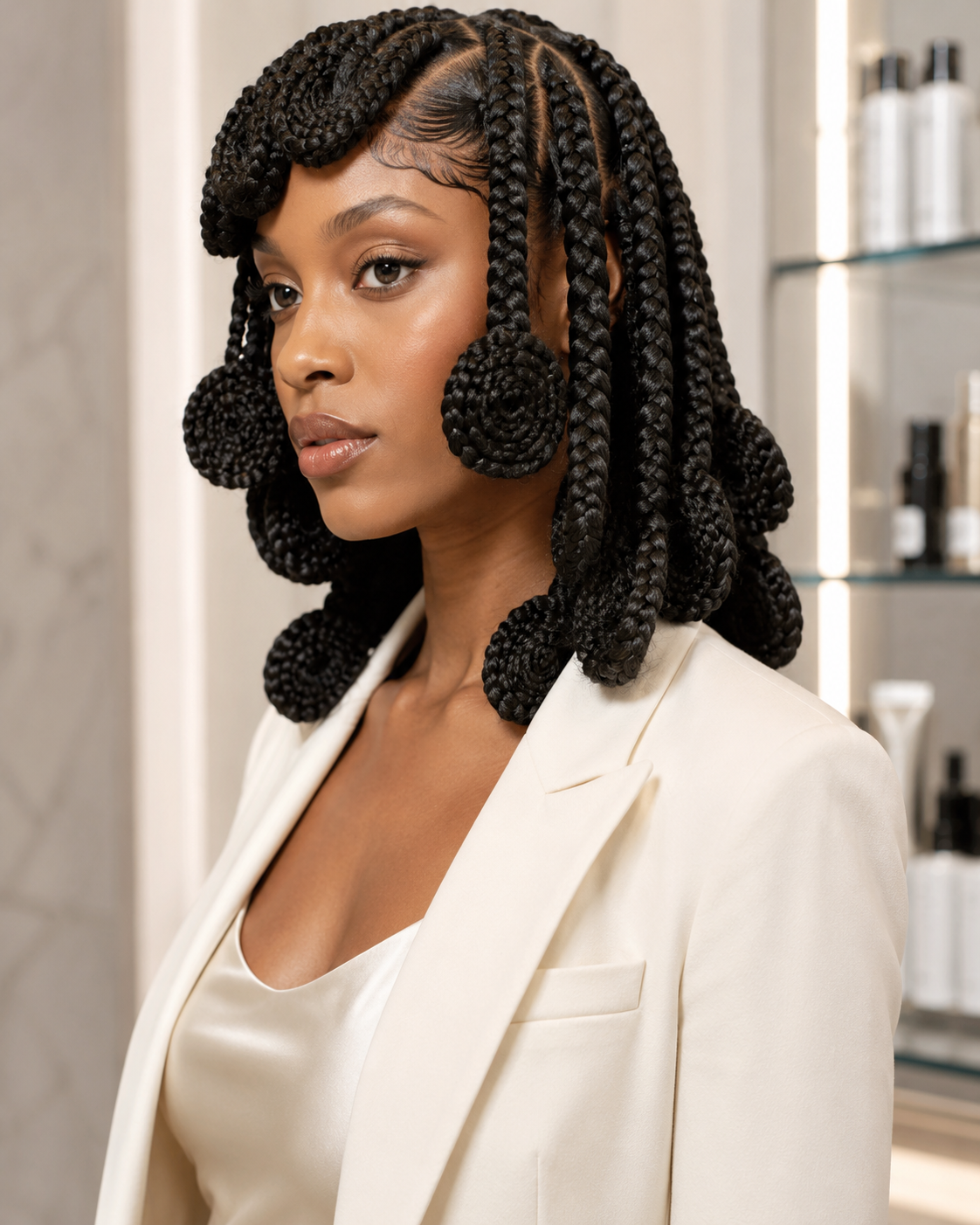
Illustration -- About our illustrations
Koroba is a Yoruba cornrow style in which every row radiates from a single focal point and runs out to the hairline on all sides, so the finished pattern encloses the head like an upturned basket or bowl. The name is commonly explained as referring to a bucket or basket.
Distinguishing characteristics
All rows share one focal point. The academic account places it at the back of the head (the occiput); other descriptions place it at the centre or crown, so the exact point varies by braider. This differs from Shuku, where rows rise from the hairline to a gathered crown finish, and from Patewo, where rows from the two sides meet at the centre. Ends are typically finished around the head, often in small knots, coils or beads.
Advantages
A distinctive traditional pattern that works on natural hair alone or with added length.
Considerations
The centre point has to be placed precisely, so it needs an experienced braider.
Warning signs
Tenderness at the crown or hairline, or bumps along the rows, mean the braids are too tight.
Preparation
Ask your braider to show where the centre point will sit; it sets the whole pattern. Start with clean, stretched hair and agree whether extension hair and beads will be added.
Daily Care
Moisturise the ends lightly and keep the rows flat with your palms.
Night Care
Cover with a satin scarf or bonnet so the radiating rows stay neat.
Washing
Cleanse the scalp between the rows with diluted shampoo and rinse thoroughly; dry the ends fully.
Scalp Care
The crown, where all the rows begin, can collect product; use light products and check it for tenderness.
Refreshing
Re-roll or re-knot the ends and smooth frizz with mousse.
Removal
Undo the ends, then unravel each row from the hairline back towards the crown.
Styling tips
Beaded ends, waist-length extension versions and warm brown colours are popular variations.
At a glance
- Estimated price
- $50–$165
Planning estimate, not a validated market benchmark -- local salon pricing varies and this figure should not be treated as a typical or standard price. - Chair time
- 2–4 hrs
- Sizes
- Medium
- Lengths
- Scalp Style, Waist Length
- Looks
- 4 looks
Looks
- Classic Koroba Braids -- Medium, Scalp Style, Natural Black, Curled
- Koroba Braids with Beads -- Medium, Scalp Style, Dark Brown, Curled
- Waist-Length Koroba Braids -- Medium, Waist Length, Natural Black, Curled
- Medium Brown Koroba Braids -- Medium, Scalp Style, Medium Brown, Curled
Price & time
- Estimated price: $50–$165
- Estimated time: 2–4 hrs
- Confidence: Low
Planning estimate, not a validated market benchmark -- local salon pricing varies and this figure should not be treated as a typical or standard price.
Estimate only -- no direct source; not region-specific.
Culture & history
Koroba Braids and the Yoruba Inverted-Calabash Tradition
Koroba braids originate among the Yoruba people of Nigeria; the name itself means calabash/bucket in Yoruba, describing the style's signature silhouette -- cornrows that begin at the crown and spiral outward and downward, with the ends rolled or coiled into rounded bubbles, producing an inverted-basket profile. This is a genuinely distinct construction from the catalog's other cornrow-based styles: the radiating from-crown pattern and the rolled-bubble end treatment are both load-bearing parts of the style's identity, not cosmetic variants of straight-back or feed-in cornrows.
Related styles
- Shuku -- Directionally opposite cornrow constructions: Koroba Braids radiate from the crown outward and downward into rolled, bubble-ended tips (an inverted-basket profile), while Shuku is braided from the head's perimeter inward and upward, converging at the crown into a raised conical hump -- independent Yoruba-hairstyling sources describe these as mirror-image constructions. Compare