Habesha Braids
Cornrow Construction Family
Also known as: Albaso, Tigray Braids
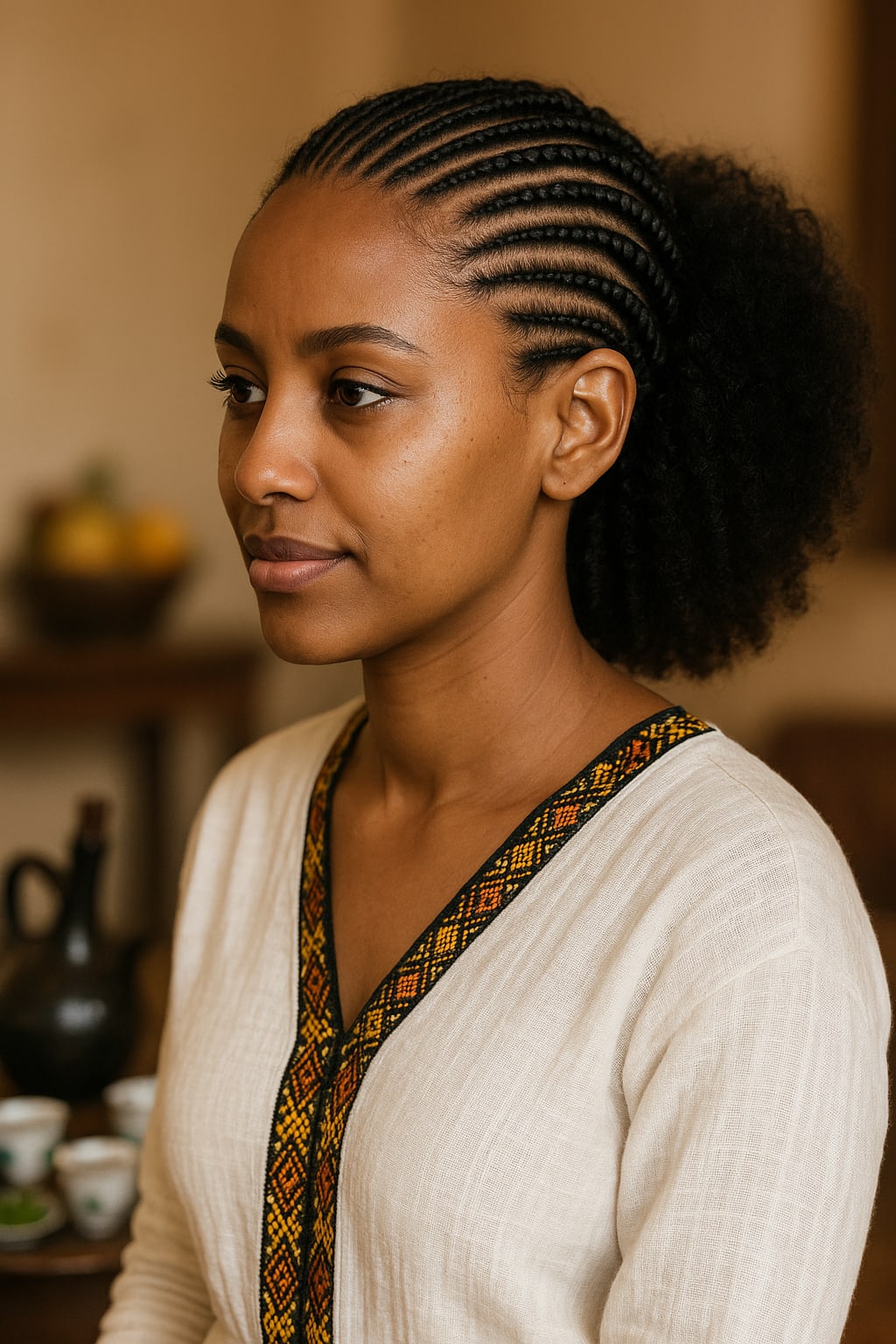
Illustration -- About our illustrations
Habesha braids are a family of Ethiopian and Eritrean hairstyles built from fine, close cornrows, often finished with loose, voluminous curly hair at the back. Named designs include shuruba (fine braids) and albaso, which alternates thicker and thinner rows and can include a raised centre; Asa Shuruba is a traditional bridal version with fine rows fanning back and a raised centre ridge.
Distinguishing characteristics
Very fine scalp braids travelling towards the back and sides, with the length either left loose and curly (sometimes shaped into a puff) or gathered and braided down. Designs and names vary between communities and families, so ask your braider which named design you are booking.
Advantages
Offers a clearly planned scalp pattern and room for an individually agreed crown arrangement. Length and adornment can be discussed separately from the underlying row design.
Considerations
The broad label can conceal important regional and construction differences. Detailed rows take care to install and remove; an elaborate arrangement must not depend on painful tension.
Warning signs
Loosen rows that cause pain, stinging or raised scalp skin. Continuing irritation or loss along partings needs medical assessment.
Preparation
Agree on the design name, row direction, centre treatment and how the back will be finished. Arrive with clean, gently detangled hair; fine rows need a smooth but not over-tight base.
Daily Care
Handle the lengths without repeatedly pulling across the crown pattern. Keep accessories from snagging the rows and leave enough access to inspect the scalp.
Night Care
Use loose protection shaped around the arrangement rather than compressing a raised portion. Avoid tying a covering tightly across the front rows.
Washing
Agree on gentle scalp cleansing and thorough drying for the exact arrangement and any added fiber. A ceremonial or intricate pattern does not remove the need for scalp hygiene.
Scalp Care
Check along the rows and the perimeter, especially where the design changes direction. Do not use edge product to disguise tenderness or inflamed areas.
Refreshing
Have loosening rows redone without tightening the whole design. Re-fluff loose curly hair at the back with water and a light leave-in.
Removal
Remove accessories first, then undo rows and separate shed hair gently. Seek help where fine rows or added hair make the natural-hair boundary difficult to identify.
Styling tips
Bring a photo and the name of the design you want, such as shuruba or albaso. A loose curly back suits celebrations; braiding the length down lasts longer. Gold accessories are a popular finish for weddings and holidays.
At a glance
- Estimated price
- $100–$300
Planning estimate, not a validated market benchmark -- local salon pricing varies and this figure should not be treated as a typical or standard price. - Chair time
- 2–6 hrs
- Sizes
- Extra Small
- Lengths
- Mid-Back Length, Waist Length
- Looks
- 4 looks
Looks
- Medium Mid-Back Habesha Braids -- Extra Small, Mid-Back Length, Natural Black, Natural Ends
- Crown-Part Habesha Braids -- Extra Small, Mid-Back Length, Natural Black, Natural Ends
- Waist-Length Habesha Braids -- Extra Small, Waist Length, Natural Black, Natural Ends
- Dark Brown Crown-Part Habesha Braids -- Extra Small, Mid-Back Length, Dark Brown, Natural Ends
Price & time
- Estimated price: $100–$300
- Estimated time: 2–6 hrs
- Confidence: Low
Planning estimate, not a validated market benchmark -- local salon pricing varies and this figure should not be treated as a typical or standard price.
Estimate only -- no direct US salon source found; not region-specific.
Culture & history
Habesha Braids (Albaso): A Fine Radiating Cornrow Tradition
Habesha Braids (locally called Albaso) fan out in fine cornrows from a center or crown part, braided outward and downward into a smooth, voluminous, downward-flowing coif at the back -- a distinct construction from the cornrow patterns already in this catalog (Fulani, Ghana, Tribal), none of which share this specific fanning-from-center, flat-finish (no rolled or beaded ends) silhouette. Documented in contemporary editorial coverage and practiced by dedicated Habesha diaspora salons in the US.