Ghana Braids
Cornrow Construction Family
Also known as: Banana plaits, Ghana weaving, Banana braids, Etisalat hair
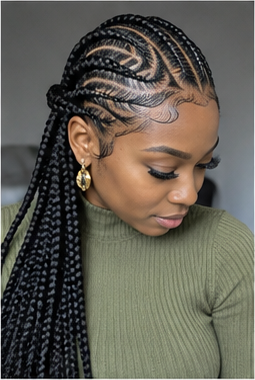
Illustration -- About our illustrations
Ghana braids are feed-in cornrows: braids that lie flat against the scalp in continuous rows, with extension hair added a little at a time so each row starts slim and becomes fuller towards the end. The result is a smooth, tapered row that looks neat at the hairline and full along its length.
Distinguishing characteristics
What sets Ghana braids apart from plain cornrows is the progressive feed-in: hair is added under the working strands in small amounts as the row travels, rather than all at the start. Rows are usually medium to large and are commonly laid straight back, curved or swept to one side. The name is a modern label; the underlying cornrow technique belongs to a long West African braiding tradition.
Advantages
A neat, versatile cornrow style with a natural-looking start at the root. Installs faster than many individual-braid styles and works for all lengths of natural hair.
Considerations
New growth shows quickly along the parts. Large rows with a lot of added hair can feel heavy at first.
Warning signs
Tight, painful rows, raised bumps along the parts or hairline, or patches of thinning are signs of traction; take the style down early and give your edges a rest.
Preparation
Choose the number of rows and their direction before the appointment. Wash, condition, detangle and stretch your hair. Ask your stylist to start each row small but not pinched at the hairline.
Daily Care
Lightly moisturise the rows and keep heavy creams off the parts to avoid buildup. Avoid pulling the rows into tight high ponytails.
Night Care
Sleep with a satin scarf or bonnet to keep the rows flat and reduce frizz.
Washing
Cleanse the scalp between the rows with diluted shampoo every one to two weeks, rinse thoroughly and blot dry. Make sure the rows dry fully to avoid odour.
Scalp Care
Use a light oil or scalp spray on visible parts if your scalp feels dry. Keep an eye on the first centimetre of each row at the hairline, where tension is highest.
Refreshing
A little mousse and a scarf tied for a short while will lay down flyaways. Many stylists can redo just the front rows.
Removal
Cut the extension hair below your natural ends, unravel each row from its tail, and detangle shed hair gently before washing.
Styling tips
Straight-back rows are the classic; curved rows, side-swept patterns, a mix of row sizes, beads on the ends, or rows gathered into a ponytail or bun are popular alternatives.
At a glance
- Estimated price
- $50–$300
Planning estimate, not a validated market benchmark -- local salon pricing varies and this figure should not be treated as a typical or standard price. - Chair time
- 2–6 hrs
- Sizes
- Medium, Small, Large
- Lengths
- Waist Length
- Looks
- 8 looks
Looks
- Classic Straight-Back Ghana -- Medium, Waist Length, Natural Black, Soft Swoops, Tapered
- Small Ghana Braids -- Small, Waist Length, Natural Black, Soft Swoops, Tapered
- Large Ghana Braids -- Large, Waist Length, Natural Black, Soft Swoops, Tapered
- Curved Ghana Braids -- Medium, Waist Length, Natural Black, Soft Swoops, Tapered
- Side-Swept Ghana Braids -- Medium, Waist Length, Natural Black, Soft Swoops, Tapered
- Ghana Ponytail -- Medium, Waist Length, Natural Black, Soft Swoops, Tapered
- Mixed-Size Ghana Braids -- Medium, Waist Length, Natural Black, Soft Swoops, Tapered
- Beaded Ghana Braids -- Medium, Waist Length, Natural Black, Soft Swoops, Tapered
Price & time
- Estimated price: $50–$300
- Estimated time: 2–6 hrs
- Confidence: Low
Planning estimate, not a validated market benchmark -- local salon pricing varies and this figure should not be treated as a typical or standard price.
US national estimate, conflicting sources.
Culture & history
Ghana Braids: African and West African braiding traditions
Ghana Braids: a feed-in cornrow variant with modern naming
FAQs
- What are Ghana Braids?
Ghana braids are tapered feed-in cornrows that begin narrow and progressively increase in thickness as extension hair is added.
- How are Ghana braids different from cornrows and feed-in braids?
Ghana braids are feed-in cornrows, so they're very close to what many salons call feed-in braids. Compared with plain cornrows, extension hair is added a little at a time, so each row starts slim and gets fuller; Ghana rows are usually medium to large.
- Should Ghana Braids hurt?
No. Large rows with a lot of added hair can feel heavy at first, but they shouldn't hurt. Pain, stinging, a headache, a tight or tented scalp, or small bumps mean it's too tight: ask for those rows to be loosened or redone straight away rather than waiting for them to settle.
- Do Ghana Braids require extension hair?
Yes. Feeding in extension hair a little at a time is what makes Ghana braids taper from slim to full. Ask how much hair the stylist needs and whether it's included in the price.
- How long can I keep Ghana Braids installed?
Up to about 6–8 weeks, the limit the American Academy of Dermatology suggests for braids. New growth shows quickly along the parts, so many people refresh them sooner; take them out straight away if they hurt or your edges start to thin.
Related styles
- Feed-In Braids -- Ghana Braids is defined by a shape/silhouette profile rather than the feed-in hair-addition method specifically, though the two techniques are frequently combined in practice. Compare
- Cornrows -- Research on Ghana Braids concludes "the literature generally treats Ghana braids as a cornrow variant rather than a wholly separate category," describing them as feed-in cornrows that produce a tapered, thicker row than a plain cornrow. Compare
- Shuku -- Ghana Braids are documented in this catalog as a linear, flat-lying feed-in cornrow variant; Shuku's fine cornrows instead converge upward into a raised three-dimensional crown protrusion -- a genuinely different silhouette despite both starting from cornrow construction, which is also why this catalog's prior "Shuku"/"Feed-in shuku hairstyles" alternate-name entries under Ghana Braids and Feed-In Braids were incorrect and are corrected in this same file. Compare