Fulani Braids
Cornrow Construction Family
Also known as: Fulani hairstyle, Fulani style
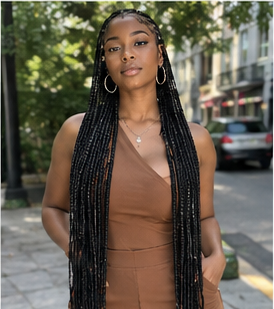
Illustration -- About our illustrations
Fulani braids combine cornrows and hanging braids in one design. A common layout has a cornrow running down the center of the head from front to back, cornrows on the sides braided toward the face, and individual braids that hang free around the face and at the back. They're often decorated with beads, cuffs or other accessories. The style is named after, and inspired by, braided hairstyles of the Fula (also called Fulani or Fulɓe) people of the Sahel region of West Africa. Salon versions today are modern interpretations that vary a lot, so there's no single correct pattern.
Distinguishing characteristics
Look for the mix: flat cornrows on the scalp plus free-hanging braids, usually arranged around a center row, with braids framing the face. That combination separates Fulani braids from plain cornrows, which have no hanging braids, and from box or knotless braids, which hang from individual sections all over the head. Lemonade braids also start as cornrows, but they sweep everything to one side; Fulani layouts are usually centered and balanced.
Advantages
A striking design that mixes flat and hanging braids. Easy to personalize with beads, cuffs, color and curly ends. The face-framing braids give a finished look with little daily styling, and the style works from bob length to very long.
Considerations
The mixed layout takes planning and skill, and prices vary widely between braiders. Beads and other accessories add weight and can snag. Both the face-framing braids and the cornrows sit on your hairline, so tension there needs watching.
Warning signs
Fulani braids should not hurt at any point. Stinging, persistent soreness, bumps, crusts, skin tenting at the base of a braid, or a headache means something is too tight, so have it loosened or taken out. Pay close attention to the face-framing braids and check your edges monthly for broken hairs or thinning. Keep the style in for 6–8 weeks at most, in line with American Academy of Dermatology guidance on braids. See a board-certified dermatologist if irritation or hair loss persists.
Preparation
Start with clean, conditioned, detangled hair. Bring a photo of the layout you want, including the center and side rows, where the hanging braids begin and whether you want beads, because layouts differ a lot between braiders. If you plan to add plenty of beads or cuffs, factor in the extra weight, and mention any thinning or tenderness at your edges before braiding starts.
Daily Care
Check that beads and cuffs are smooth and secure, and remove any that feel heavy or catch on your hair. Keep scalp products light. Be gentle with the face-framing braids; they sit right at your hairline and get handled the most.
Night Care
Cover your hair with a satin or silk scarf or bonnet. If you've added beads, gather the braids loosely so the beads don't tug on the hair while you sleep.
Washing
Wash your scalp with diluted shampoo along the parts and rinse well; the cornrow sections are easy to reach. Handle beaded braids carefully, squeezing water out rather than wringing, and make sure both the cornrows and the hanging braids dry completely.
Removal
Take off all beads and cuffs first. Unravel the hanging braids from the ends up, then undo the cornrows row by row. Avoid cutting close to your own hair, and gently finger-detangle shed hair before washing.
Cultural context
The style takes its name from the Fula (Fulani, Fulɓe) people of the Sahel, whose braided hairstyles inspire it. Most salon versions are modern interpretations rather than reproductions of a specific traditional style, so describing them as Fulani-inspired is accurate.
At a glance
- Estimated price
- $100–$350
Planning estimate, not a validated market benchmark -- local salon pricing varies and this figure should not be treated as a typical or standard price. - Chair time
- 2–7 hrs
- Sizes
- Medium, Small
- Lengths
- Mid-Back Length, Shoulder Length, Waist Length
- Looks
- 8 looks
- Occasions
- Cultural Event: Well suited
Work / Office: Well suited
Vacation: Suited with tradeoffs
Looks
- Classic Fulani Braids -- Medium, Mid-Back Length, Natural Black, Soft Swoops, Tapered
- Fulani Braids with Beads -- Medium, Mid-Back Length, Natural Black, Soft Swoops, Tapered
- Fulani Braids Bob -- Medium, Shoulder Length, Natural Black, Soft Swoops, Tapered
- Long Fulani Braids -- Medium, Waist Length, Natural Black, Soft Swoops, Tapered
- Fulani Braid Ponytail -- Medium, Mid-Back Length, Natural Black, Soft Swoops, Tapered
- Small Fulani Braids -- Small, Mid-Back Length, Natural Black, Soft Swoops, Tapered
- Fulani Braids with Curly Ends -- Medium, Mid-Back Length, Natural Black, Soft Swoops, Tapered
- Fulani Braids with Center Braid -- Medium, Mid-Back Length, Natural Black, Soft Swoops, Tapered
Price & time
- Estimated price: $100–$350
- Estimated time: 2–7 hrs
- Confidence: Medium
Planning estimate, not a validated market benchmark -- local salon pricing varies and this figure should not be treated as a typical or standard price.
US estimate. Price varies with braid size, length and accessories.
Occasion & climate fit
Cultural Event
Occasion · Well suited
Work / Office
Occasion · Well suited
Vacation
Occasion · Suited with tradeoffs
FAQs
- What are fulani braids?
Fulani braids mix cornrows and hanging braids. A common layout has a cornrow down the centre of the head, side cornrows braided toward the face, and individual braids that hang around the face and at the back, often with beads or cuffs. The style is inspired by braided hairstyles of the Fulani (Fula) people of West Africa and the Sahel; today's salon versions vary and aren't exact copies of any one traditional style.
- How are fulani braids constructed?
Usually the centre and side cornrows are braided first, often with feed-in hair, then the rest of the hair is done as individual braids that hang free. Beads or cuffs go on last.
- Should fulani braids hurt?
No. The face-framing braids and the cornrows both sit on your hairline, and beads add weight, so the edges take the most strain. Pain, stinging, a headache, a tight or tented scalp, or small bumps mean it's too tight: ask for those braids to be loosened or redone straight away rather than waiting for them to settle.
- How long can fulani braids be worn?
Up to about 6–8 weeks, the limit the American Academy of Dermatology suggests for braids. Beads and cuffs add weight to the face-framing braids, so take them out sooner if your edges feel sore or start to thin.
Related styles
- Cornrows -- Fulani braids are built on cornrows, usually a center row plus side rows toward the face, combined with braids that hang free. Compare
- Tribal Braids -- Research on Tribal Braids finds "in contemporary salons and media, the term 'tribal braids' is most often used as a catch-all for Fulani braids or Fulani-inspired looks," with 2022+ content frequently tagging the two together. Compare
Sources
- Traction alopecia (DermNet New Zealand)
- Hairstyles that pull can lead to hair loss (American Academy of Dermatology Association)