African Hair Threading
Thread-Wrap Family
Also known as: Hair Threading, Irun Kiko
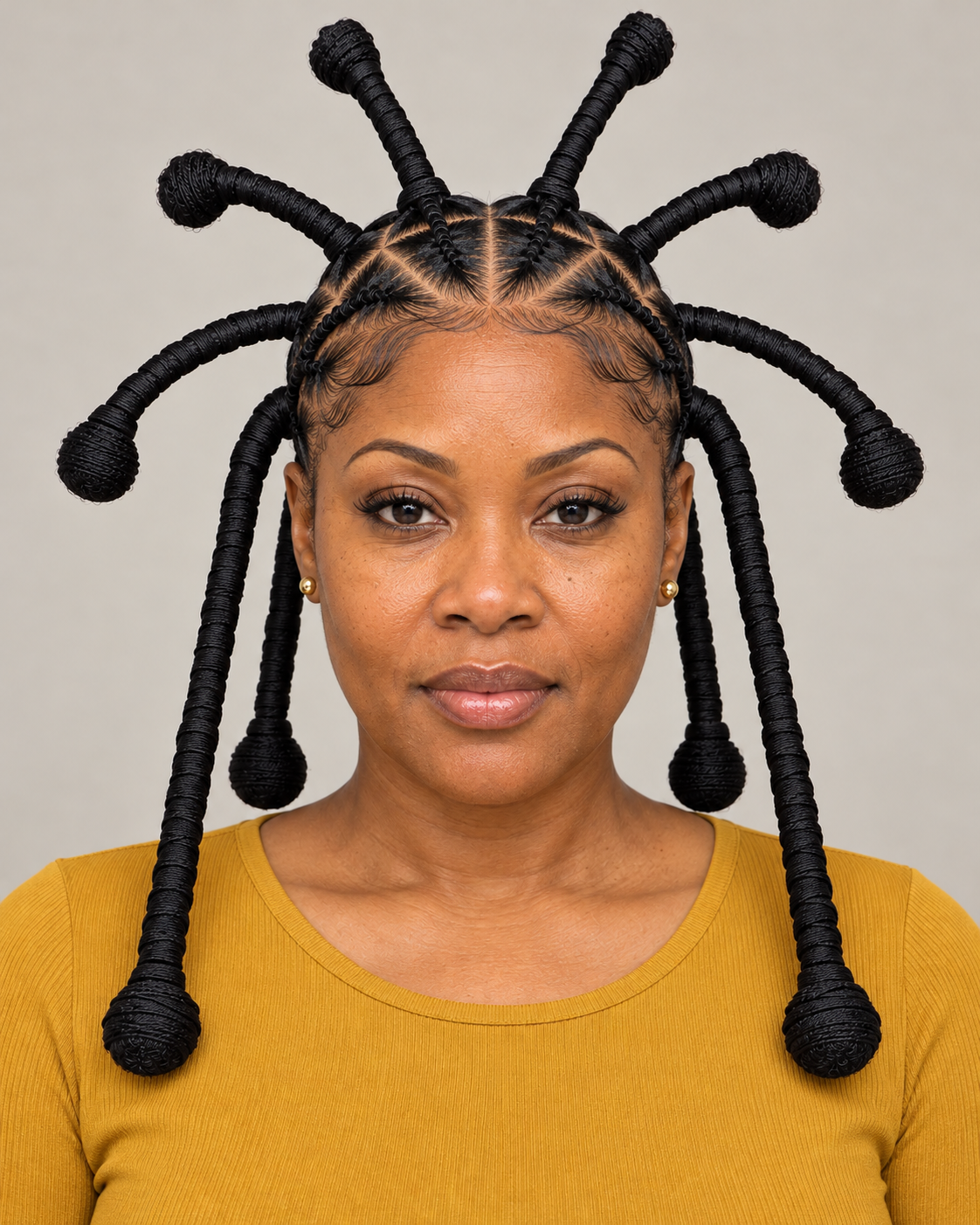
Illustration -- About our illustrations
African Hair Threading shapes sections by winding thread around the hair rather than crossing the hair into a braid. The wrapped sections create a sculptural finish; the thread can also be removed to reveal stretched hair, with the result depending on the starting texture and wrapping plan.
Distinguishing characteristics
The thread forms the visible outer cylinder while the wearer's hair remains inside. Coverage, spacing and section layout distinguish this from yarn braids, where yarn is incorporated into a plait. Thread wrapping is recognized in professional braiding standards; that does not establish one universal regional pattern.
Advantages
Offers a distinctive wrapped silhouette and an alternative to a braided finish. The thread can supply visible color without coloring the natural hair.
Considerations
Thread coverage makes the inner hair harder to inspect. Care, removal and the released finish depend on the fiber and wrapping method; this is not a maintenance-free or guaranteed damage-free service.
Warning signs
Loosen or remove a wrap that pulls, hurts or produces bumps. Seek medical assessment for continuing scalp symptoms or thinning.
Preparation
Discuss the desired wrapped finish versus a later stretched-out finish. Start with detangled hair and a clean scalp; ask the stylist to show where the thread will begin and end and how it will be removed. Disclose past reactions to fibers or styling products.
Daily Care
Handle wrapped sections at their lengths rather than tugging on the bases. Keep jewelry and clothing fasteners from catching exposed thread ends. A loose thread is a reason to assess the wrap, not to tighten the root.
Night Care
Arrange the sections in a comfortable position under a loose, smooth covering. Avoid folding a stiff wrapped section so that it levers against the scalp.
Washing
Agree on a cleansing and drying method for the actual thread before installation. If the scalp cannot be cleaned comfortably, plan removal rather than deferring hygiene to preserve the finish.
Scalp Care
Keep the partings accessible for inspection. Do not hide soreness beneath more thread or product.
Refreshing
Have a slipping wrap checked or redone without increasing root tension. Removing the thread changes the hairstyle; do not promise that the released hair will look chemically straightened.
Removal
Unwind in manageable sections. Do not cut close to concealed natural hair; seek help if the thread is entangled or its ends cannot be distinguished.
Styling tips
Choose whether you want the wrapped sections to remain visible or intend to release them later. Discuss their direction and how they will sit against clothing before wrapping begins. Keep any gathered arrangement loose enough that a stiff section does not pull at its base; added decorations need their own attachment plan.
At a glance
- Estimated price
- $50–$150
Planning estimate, not a validated market benchmark -- local salon pricing varies and this figure should not be treated as a typical or standard price. - Chair time
- 1.5–3 hrs
- Sizes
- Small
- Lengths
- Shoulder Length, Waist Length
- Looks
- 4 looks
Looks
- Small Shoulder-Length Wool-Thread Hair Threading -- Small, Shoulder Length, Natural Black
- Small Shoulder-Length Cotton-Thread Hair Threading -- Small, Shoulder Length, Natural Black
- Small Shoulder-Length Nylon-Thread Hair Threading -- Small, Shoulder Length, Natural Black
- Long Waist-Length Wool-Thread Hair Threading -- Small, Waist Length, Natural Black
Price & time
- Estimated price: $50–$150
- Estimated time: 1.5–3 hrs
- Confidence: Low
Planning estimate, not a validated market benchmark -- local salon pricing varies and this figure should not be treated as a typical or standard price.
Estimate only for price -- no direct US-dollar source found; time figure is real but from general braiding context, not Threading-specific.
Culture & history
African Hair Threading: A Non-Braided, Thread-Wrapped Construction
African hair threading wraps sectioned hair tightly, root to tip, with wool, cotton, or nylon thread instead of braiding, twisting, or adding an extension strand -- the wrapped thread itself both stretches and holds the section, producing a smooth, elongated look with no braid pattern at all. This is a categorically different construction from every braided, twisted, or loc-based style in this catalog and has real historical documentation and continued practice as a protective style.
FAQs
- How is African Hair Threading different from yarn braids?
Threading wraps thread around a section of hair from the outside; yarn braids braid the yarn into the plait itself. Ask the stylist which construction you are booking, because the two can look similar in photos.